THE SEA'S EDGE
The coast that made the first sailors ★ The place is a character

Here the land runs out. This coast is not a backdrop, it is a character in the story: the same karst that holds Tebo's cave, at the edge where our kind first looked at the open sea and chose to cross it.
The Sangkulirang-Mangkalihat karst of East Kalimantan, the same limestone country that holds Liang Tebo, running out to the sea.
These cliffs carry some of the oldest figurative art on Earth: red-ochre hand stencils and a painted wild ox, around 40,000 years old.
Along this coast our ancestors built rafts and crossed open water to a land they could not see, the first ocean voyagers.
A migration of the mind that ran until it met the sea, and then kept going.
Geography as a character
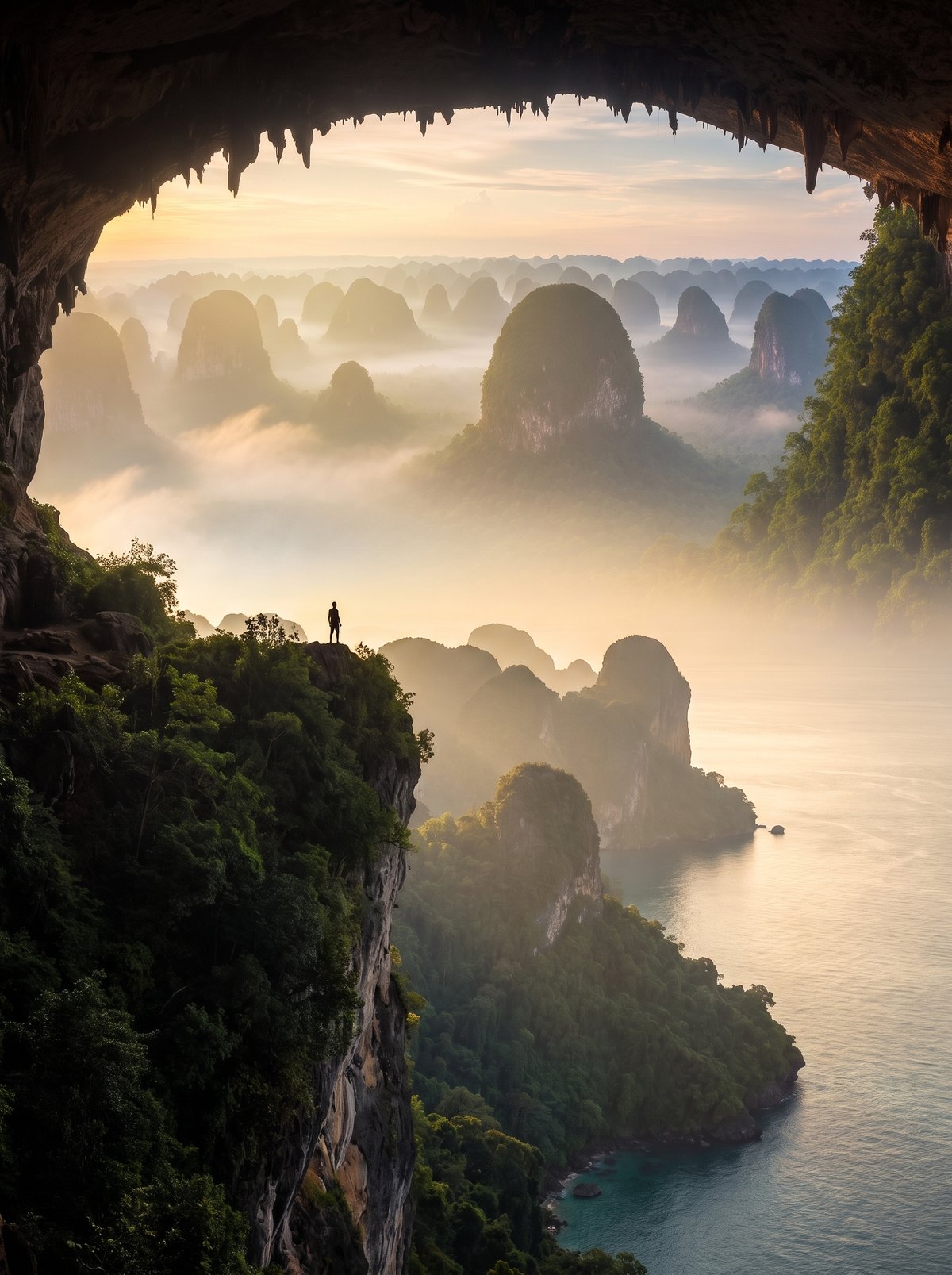
The land itself carries the story to the water.
- The Sangkulirang-Mangkalihat karst of East Kalimantan is the same limestone country that holds Liang Tebo. Its towers, caves and coast are the physical world of the book, and the shape of the land drives the journey. WE
- In the Ice Age the sea stood lower and much of Sundaland was dry land, so the coastline sat further out and the great crossings lay beyond it. WE
- We treat the place as a character in its own right: a land that keeps offering an edge, and a sea that keeps offering a question. S
The oldest art, at the edge
The mind that would cross the sea left its mark on the way there.
- Caves in this same karst, above all Lubang Jeriji Saleh, hold red-ochre hand stencils and a painted wild ox dated to around 40,000 years, among the oldest figurative art known anywhere on Earth. WE
- Whether these are strictly the oldest is still argued, with similar ages on Sulawesi across the water. Either way, symbolic art appears here, on the migration route, remarkably early. C
- These are the deep-time ancestors of Tebo's world, not later arrivals. The hand on the wall is the same gesture the film builds toward: I was here. S
The first ocean explorers
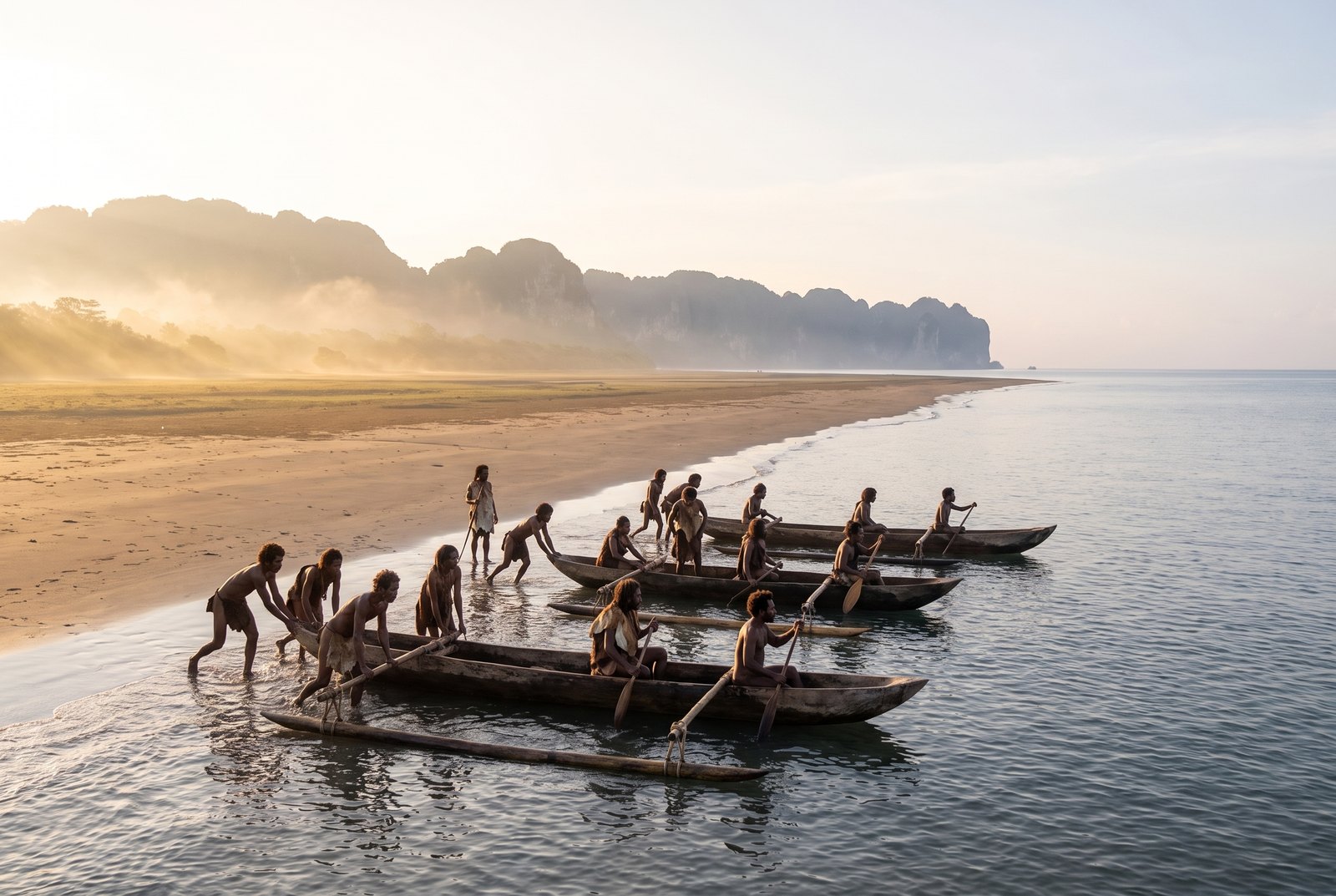
Our kind became sailors before it built a city or sowed a field.
- By around 65,000 years ago people crossed open ocean through the islands of Wallacea to reach Sahul, the joined landmass of Australia and New Guinea. It is the oldest accepted evidence of open-sea voyaging by our species. WE
- At least one leg of that route was near 100 km of open water, out of sight of land. Whether the earliest crossings were aimed or accidental is still debated, but they happened, again and again. C
- The craft itself is unknown. The first crossings most likely used simple bamboo rafts; the outrigger canoe shown here is a later technology, stood in as the emblem of the seafaring nerve that began this deep. S
- Those first voyagers were Tebo's ancestors on this very coast, tens of thousands of years deep. The story lives inside a people who had already dared the sea. S
THE HORIZON THAT PULLS. The place is a character: a karst world that keeps leading to an edge, and an ocean that keeps asking to be crossed. The oldest hands on the wall and the first rafts on the water are the same impulse the film is about, the reach of a curious mind. This is the ground that first made explorers, and it is meant to spark that same wonder in anyone who sees it.
THE BOOK OF TEBO1 · The Living World. Imagery: AI-generated concept art. Science: the Sangkulirang-Mangkalihat rock art (Lubang Jeriji Saleh) is dated to about 40,000 years (Aubert et al. 2018, Nature); the peopling of Sahul by open-sea crossing through Wallacea by about 65,000 years ago is well-established; exact ages, precedence, and whether the first crossings were intentional remain debated. Intellectual property of Epic Productions.